Window replacement is one of those home improvement decisions that homeowners often delay longer than they should. The signs of failing windows tend to appear gradually — a slight draft here, a fogged pane there — and it is easy to dismiss them as minor inconveniences rather than symptoms of a larger problem. In Pensacola’s demanding Gulf Coast climate, however, failing windows have a measurable impact on energy bills, indoor comfort, and in some cases structural integrity. Here is what to look for.
Fogging or Condensation Between the Panes
This is the clearest and most definitive sign that a double pane window has failed. The fogging you see trapped between the two glass layers is moisture that has entered the insulating cavity after the airtight seal has broken down. Once that seal fails, the inert gas fill — typically argon — escapes and the window loses its insulating performance, reverting to near single-pane thermal behaviour.
There is no repair for a failed insulating seal. The glass unit needs to be replaced, and in most cases where the seal has failed the frame condition also warrants assessment. In Pensacola’s salt-air and high-humidity environment, seal failure tends to occur earlier than the national average — particularly on windows installed before 2000 that were not specifically engineered for coastal exposure.
Drafts Around the Frame
If you can feel air movement around a closed window — particularly on a windy day or when your HVAC system is running — the window is no longer airtight. Drafts can come from several sources: failed weatherstripping around the sash, a warped frame that no longer seats correctly, cracks in the frame material, or failed caulking at the frame-to-wall joint.
Minor weatherstripping replacement can address some draft issues on otherwise sound windows. But if the frame itself has warped, cracked, or pulled away from the wall opening, repair is rarely cost-effective. A warped frame will continue to worsen over time, and in Pensacola’s heat and humidity the deterioration typically accelerates rather than stabilising.
Difficulty Operating the Window
Windows that are hard to open, hard to close, or whose locks no longer engage correctly are telling you something about the condition of the frame and hardware. Wood frames swell and warp with moisture absorption. Aluminium frames can develop corrosion that binds the sash channel. Hardware corrodes, particularly in Pensacola’s salt-air coastal environment, and eventually reaches the point where it cannot be adjusted back into correct operation.
An occasional sticky window in a particularly humid stretch of summer is not necessarily cause for concern. A window that consistently requires significant force to operate, or one whose lock no longer seats at all, is a security and functionality problem that warrants a proper assessment.
Visible Frame Deterioration
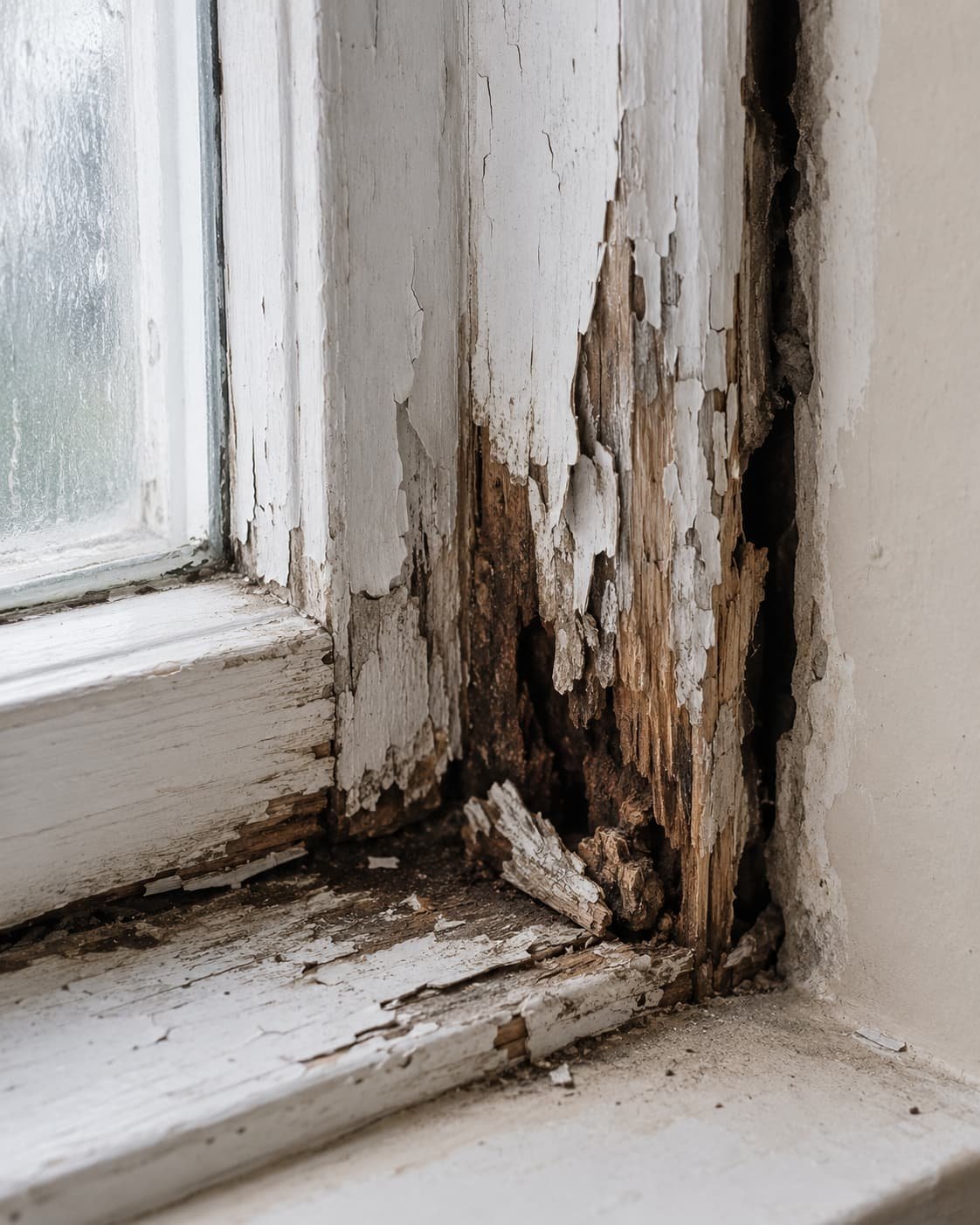
Wood frames that show peeling paint, soft spots, discolouration, or visible rot at the corners and sill are past the point of practical repair. Wood rot in a window frame does not stay contained — it spreads into the surrounding wall framing if left unaddressed, turning a window replacement job into a more complex carpentry and waterproofing repair.
Aluminium frames that show significant pitting, corrosion, or structural deformation are similarly beyond economic repair. In Pensacola’s coastal environment, aluminium-framed windows — common in homes built through the 1980s and 1990s — are particularly susceptible to accelerated corrosion from salt air exposure, especially within a few miles of the Gulf or Pensacola Bay.
Rising Energy Bills Without an Obvious Cause
If your cooling costs have been trending upward without a corresponding change in usage patterns or utility rates, your windows may be contributing more to your home’s heat load than you realise. Single-pane windows and failed double-pane units allow solar radiation and conductive heat to enter your living space continuously — forcing your air conditioning system to work harder to compensate.
In Pensacola’s climate, where air conditioning runs for six or more months of the year, that additional load adds up quickly. Homeowners who replace single-pane or failed double-pane windows with ENERGY STAR-rated double pane units with Low-E coatings typically report cooling cost reductions of 15 to 30 percent — a return that compounds every year the new windows are in service.
Excessive Outside Noise
Modern double pane windows provide meaningful acoustic insulation compared to single-pane glass or failed double-pane units where the insulating seal has broken. If outside noise — traffic, neighbours, wind — seems louder than it used to be or louder than you would expect for your location, it can be a secondary indicator of glazing performance loss. Impact-rated laminated glass, increasingly common in Pensacola’s coastal market, provides even greater noise reduction as a secondary benefit alongside its primary storm protection function.
Your Windows Are More Than 20 Years Old
Even windows that appear to be functioning correctly have a finite lifespan. In Pensacola’s Gulf Coast environment — high UV, salt air, humidity, and storm exposure — that lifespan is typically shorter than national averages suggest. Windows installed before 2005 are increasingly approaching or past the point where proactive replacement makes more financial sense than waiting for failure.
If your home still has its original windows from the 1980s or 1990s, a professional assessment is worthwhile regardless of whether obvious symptoms are present. We provide free in-home assessments with no obligation — call (850) 655-0676 or complete our free estimate form and we will be in touch within one business day.