Energy efficient windows are one of the most effective upgrades a Pensacola homeowner can make — but the terminology can be confusing and the marketing claims from manufacturers are not always straightforward. This guide breaks down what actually makes a window energy efficient, which specifications matter most in Florida’s Gulf Coast climate, and how to make a confident product decision before your next window replacement project.
Why Energy Efficiency Matters More in Pensacola Than Most Markets
Pensacola sits in ENERGY STAR’s Southern climate zone — the zone with the most demanding solar heat gain requirements in the continental United States. The combination of intense year-round UV exposure, summer temperatures regularly exceeding 90°F, and high humidity means that windows are working against your air conditioning system for a significant portion of the year. In markets like ours, poorly performing windows are not just a comfort issue — they are a meaningful ongoing energy cost.
Florida homeowners spend more on cooling than almost any other state. Air conditioning accounts for the single largest share of household electricity use across the Florida Panhandle, and a significant portion of that cooling load enters the home through windows — both as solar radiation through the glass and as conducted heat through the frame and seals. The right windows reduce both pathways simultaneously.
The Key Specifications to Understand
Solar Heat Gain Coefficient (SHGC) — This is the most important specification for Pensacola homeowners. SHGC measures how much solar radiation passes through the glass into your home. The scale runs from 0 to 1 — lower is better for blocking heat in a hot climate. For south and west-facing windows in Pensacola, look for an SHGC of 0.25 or lower. ENERGY STAR’s Southern zone requirement is SHGC of 0.25 or below.
U-Factor — U-factor measures how quickly a window conducts non-solar heat. Lower is better for insulation. In Pensacola’s climate, U-factor is less critical than SHGC because conducted heat is less of a concern than solar radiation — but a lower U-factor still improves overall thermal performance and matters more in cooler months.
Low-E Coating — Low-emissivity coatings are microscopically thin metallic layers applied to the glass surface that reflect infrared radiation. In a hot climate like Pensacola’s, Low-E coatings are specifically tuned to block solar heat gain from outside while allowing visible light through. Every energy efficient window worth considering for this market should have a Low-E coating as standard.
Gas Fill — The space between panes in a double or triple pane window is filled with an inert gas — typically argon, sometimes krypton — that reduces conductive heat transfer compared to air. Argon fill is standard on quality double pane windows and adds meaningfully to thermal performance at minimal cost. Krypton performs better but costs more and is typically reserved for triple pane applications.
Frame Material — Frame material affects both thermal performance and longevity. Vinyl frames have low thermal conductivity and perform well in Pensacola’s climate. Fibreglass frames perform even better thermally and are more durable in high-UV salt-air coastal environments — at a higher cost. Aluminium frames are the worst thermal performers and are not recommended for energy-efficient applications despite their common use in older Florida homes.
ENERGY STAR Certification for Florida
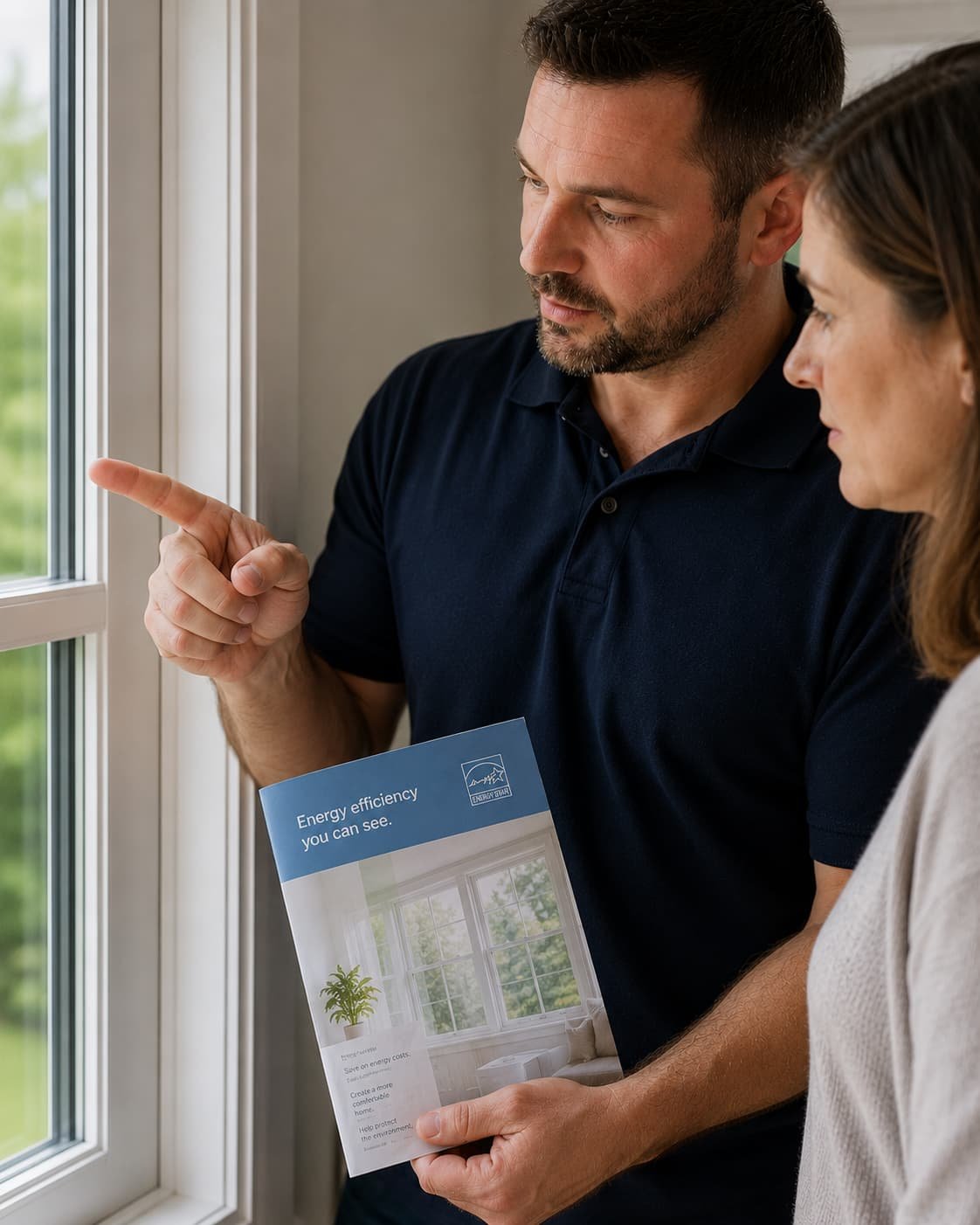
The ENERGY STAR programme certifies windows that meet specific performance thresholds for each US climate zone. Pensacola falls in the Southern zone, which has the strictest solar heat gain requirements. When selecting windows, confirm the product carries ENERGY STAR certification specifically for the Southern zone — not just a general ENERGY STAR label, which may be certified for a different climate zone with different specifications.
ENERGY STAR certified windows installed in your primary residence may also qualify for federal energy efficiency tax credits. Keep your product documentation and installer receipts — we provide ENERGY STAR certification paperwork with every qualifying installation.
Impact-Rated Windows and Energy Efficiency
Many Pensacola homeowners ask whether impact-rated windows — required or strongly recommended in coastal and hurricane-zone properties — are also energy efficient. The answer is yes. Modern impact-rated windows carry ENERGY STAR certification and meet the same Low-E and SHGC specifications as standard energy efficient windows. The laminated glass construction required for impact resistance also provides improved UV filtering and noise reduction as secondary benefits.
For homeowners in Gulf Breeze, Navarre, or other coastal Escambia and Santa Rosa County communities, impact-rated energy efficient windows are often the most practical single product choice — satisfying Florida Building Code wind-load requirements while delivering the same energy performance as a standard replacement.
Questions to Ask Before You Buy
- What is the SHGC rating, and is it certified for ENERGY STAR’s Southern zone?
- Does the window include a Low-E coating as standard, or is it an upgrade?
- What gas fill is used between the panes — argon or krypton?
- What is the frame material, and how does it perform in high-UV coastal environments?
- Does the product come with ENERGY STAR documentation suitable for tax credit applications?
If a contractor cannot answer these questions clearly and specifically, that is worth noting before you commit. Energy efficient window replacement is a significant investment — the product specifications matter as much as the installation quality.
For a free in-home estimate and product recommendation tailored to your Pensacola home, call (850) 655-0676 or complete our free estimate form and we will be in touch within one business day.